简体中文
简体中文
 English
 简体中文
简体中文 Русский
 日本語
日本語 España
 Portugal
How to Check Diode with Multimeter – Step by Step Guide
What is a Diode?
A diode is a semiconductor device that allows current to flow in only one direction. In forward bias, it conducts electricity; in reverse bias, it blocks current. Faulty diodes may become shorted (always conducting) or open (not conducting at all).
Why Check a Diode with a Multimeter?
Testing a diode helps determine if it is still functional. Common reasons include troubleshooting power supplies, diagnosing rectifiers, checking circuit boards, and preventing further damage from defective components.
Tools Needed
Digital multimeter with diode test mode (preferred)
Alternatively, a multimeter with resistance (ohm) mode
How to Check Diode with Multimeter (Step-by-Step)
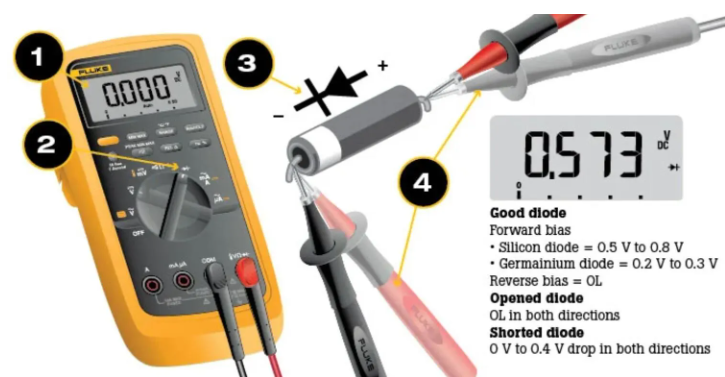
1. Power Off the Circuit
Always disconnect power before testing. For best accuracy, remove the diode from the circuit.
2. Set the Multimeter to Diode Test Mode
Select the diode symbol on your multimeter. This mode applies a small voltage to measure forward voltage drop.
3. Forward Bias Test
Red probe: anode
Black probe: cathode (marked with a stripe)
Good silicon diode: 0.5V–0.9V
Good Schottky diode: 0.2V–0.4V
4. Reverse Bias Test
Swap the probes
A good diode should show OL (no conduction)
If low both ways : shorted
If no conduction both ways : open
5. Optional: Ohmmeter Mode
In resistance mode: forward bias = low resistance; reverse bias = very high resistance.
Common Results When Checking a Diode
| Reading | Interpretation | Condition |
|---|---|---|
| 0.5–0.9V forward, OL reverse | Normal | Good diode |
| 0V both ways | Always conducting | Shorted diode |
| OL both ways | No conduction | Open diode |
| 0.2–0.4V forward | Normal (Schottky) | Good diode |
Tips for Accurate Testing
Remove at least one leg from the circuit for accurate measurement.
Let overheated diodes cool before testing.
Cross-check with the manufacturer’s datasheet.
Take safety precautions in high-voltage circuits.
Tip: Always compare diode readings with a known good component if you are unsure.
FAQ
What is a normal forward voltage for a diode?
For silicon diodes: 0.5V–0.9V. For Schottky diodes: 0.2V–0.4V.
How do you know if a diode is bad?
If it shows 0V both ways, it is shorted. If it shows OL both ways, it is open.
Can I test a diode while it’s soldered on a board?
Yes, but other components may interfere. For best accuracy, test out of circuit.